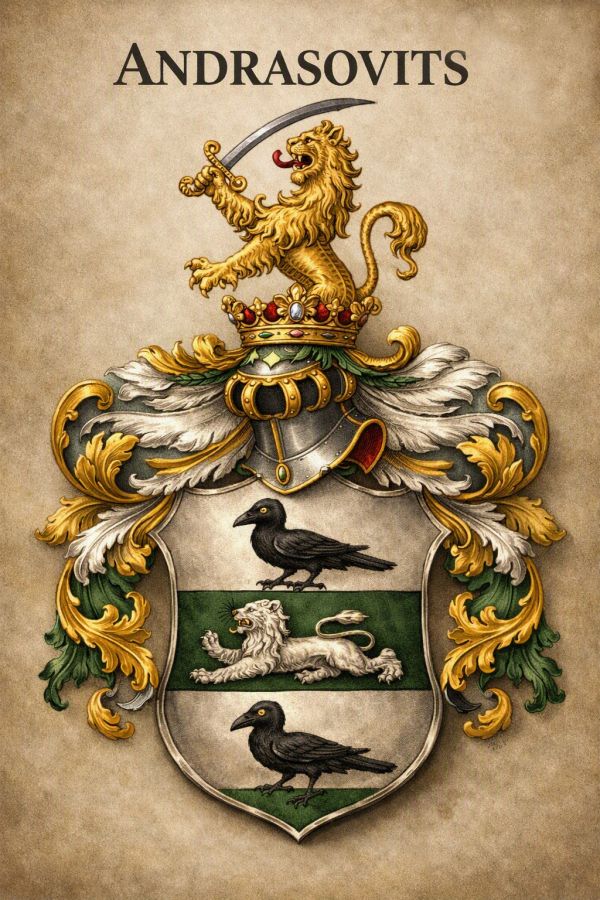
Spelling Variations include: Andrassovitz (-vits, vicz, vich), Andrašović, Andraszowicz, Andraskovitz, Andrassevich, Andrejkovitz, Andrekovič.
Means "son of Andras (Andreas/Andrew)". Andras is the Hungarian version of the Greek name "Andrew", which means 'manly', 'brave', or 'warrior'. The suffixes -ovitz, or -evich denote 'son of'. The suffix was Germanized or Hungarianized to -vitz, -witz, or -vics. For Germanic or Hungarian bureaucrats writing names down, -tz or -cs sounded like the Slavic "ch/tch" sound.
In standard Slovak, the name Andrew is Andrej, which would yield a patronymic like Andrejek or Andrekovič. However, because of centuries of Hungarian administrative rule, many locals adopted or were registered with the Hungarian variant of the first name: András.
The name is found in Southern Poland, Slovakia, and Croatia. This particular branch is from Southern Poland and Northern Slovakia (Galicia and/or Austria-Hungary) in the town of Stará Ľubovňa, or O'Lublo. Stará Ľubovňa, which sits in the historical Spiš Region right next to the Polish border, was actually pledged to the Polish Crown for about 360 years (from 1412 to 1772). Castle Lubovna was used to secure the crown jewels.
Kolodzey Connection
The Kolodzey and Andrasovitz families merge at the marriage of Andreas Kolodzey and Catharina Andrasovitz in 1811 in the town of Stara Lubovna, Slovakia.